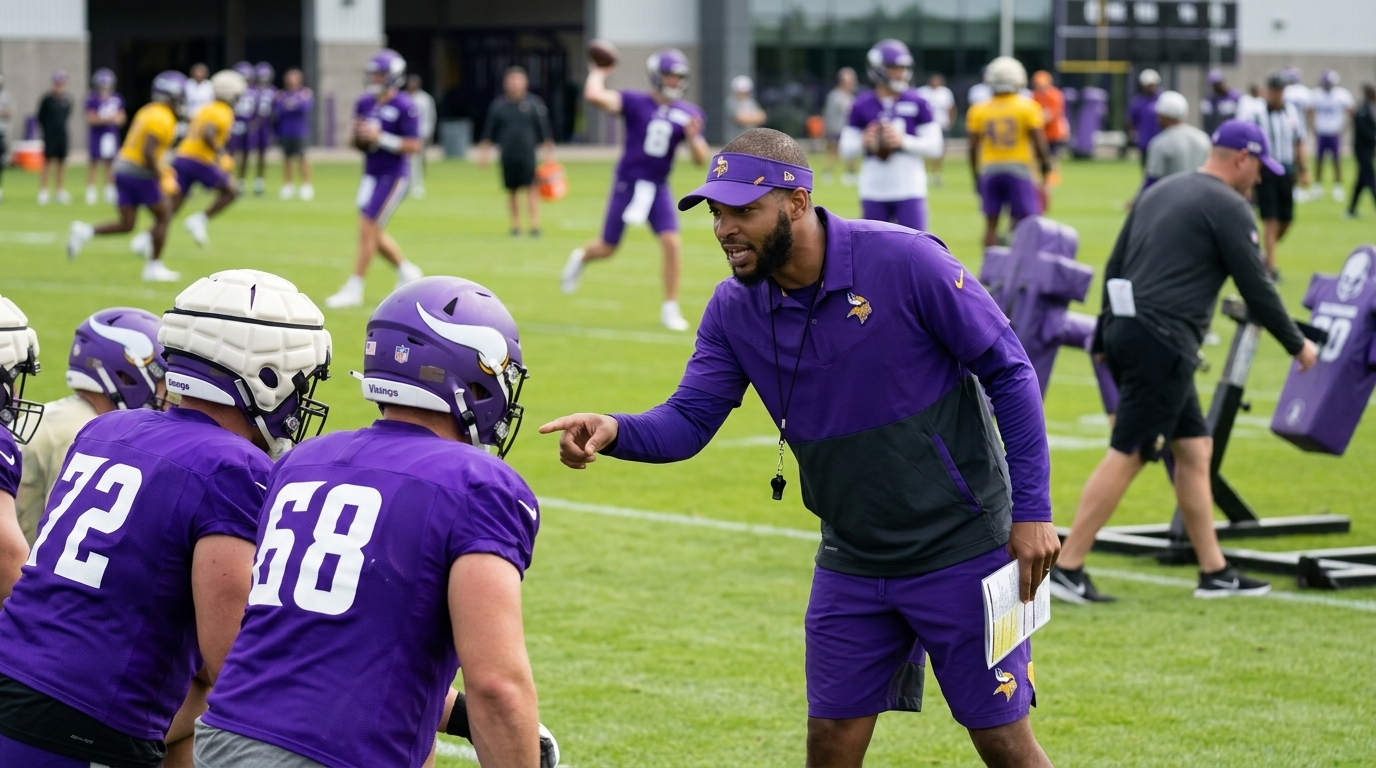
EAGAN, MN - Two weeks into training camp, the Minnesota Vikings are beginning to look considerably less mysterious than they did when players first reported. The biggest question surrounding the offense has finally been answered, several members of Minnesota's heavily defensive rookie class are already pushing for meaningful roles, and a rebuilt defense has frequently made life difficult on the offense during padded practices.
For head coach Mensah Tyler, those developments are beginning to provide a clearer picture of the team he will take into Season 36. The Vikings are coming off a 7-10 campaign in which they recovered from an 0-4 start but ultimately finished one game outside the postseason, and much of training camp has been about determining how a significantly altered roster will avoid another slow beginning.
Kyler Murray Will Lead the Offense
The biggest training camp competition is over.
Minnesota officially named Kyler Murray its starting quarterback Tuesday, ending a battle with J.J. McCarthy that stretched through the offseason program and the opening weeks of training camp. Murray and McCarthy alternated extensively between the first- and second-team offenses, with both receiving opportunities against different defensive combinations before Tyler and the Vikings finally settled on Murray.
"Kyler earned it," Tyler said. "We gave both guys every opportunity, and over the course of camp he showed us he's ready to lead this offense."
For Tyler, the decision removes what had been the biggest uncertainty surrounding the roster. It also represents a major change from the team Minnesota fielded in Season 35, when McCarthy started all 17 games and completed 65.3 percent of his passes for 3,875 yards, 27 touchdowns and 10 interceptions while finishing with a 96.5 quarterback rating.
McCarthy did enough last season that replacing him was never going to be an automatic decision, which makes Murray winning the job more meaningful. Minnesota is choosing a different direction despite receiving respectable quarterback production a year ago, and Murray's mobility gives Tyler another element to build around once Season 36 begins.
Murray has spent much of the offseason learning a new system and terminology, something he acknowledged is simply going to require repetition.
"I think it's a reps thing - continue to do it over and over again," Murray said.
Now those repetitions belong to Minnesota's QB1.
The Receiving Corps Could Make Murray's Transition Easier
Whoever won the quarterback competition was always going to inherit one of Minnesota's biggest strengths.
Justin Jefferson remains the centerpiece after catching 92 passes for 1,075 yards and nine touchdowns during Season 35, while Jordan Addison added 660 yards and three touchdowns. The offseason addition of Jauan Jennings now gives Minnesota a third established target with a different physical style from the other two receivers.
That group has been one of the more intriguing parts of camp, particularly while Murray and McCarthy worked to establish chemistry with Minnesota's receivers. Jefferson has viewed the process as something that will continue improving as the offense spends more time together.
"I see a lot of great plays being made out there. I see, really, a lot of learning out there," Jefferson said.
Murray has already shown flashes of developing that connection, including sharp work with Jennings through the middle of the field. The veteran receiver's physicality adds another dimension alongside Jefferson and Addison and could become especially valuable when defenses try to dictate matchups.
There has been one minor interruption. Addison has been dealing with a thumb injury that temporarily removed him from team drills, although the Vikings do not believe the issue will keep him sidelined for long.
If the group remains healthy, Tyler will have plenty of options when designing the Season 36 passing game around Murray.
Minnesota Is Trying to Fix the Running Game, Too
The quarterback competition has understandably dominated attention, but another offensive change may prove just as important once Season 36 begins.
Minnesota averaged only 95.6 rushing yards per game during Season 35, compared with 225.1 yards through the air. The Vikings still managed 379 points, but the offense often leaned much more heavily on McCarthy and the passing game than it did on a consistent ground attack.
Training camp has featured a noticeable effort to improve that balance. Minnesota has worked on creating more movement up front and establishing a running game capable of forcing defenses to respect more than Murray and the passing attack.
A significant part of that responsibility falls on the offensive line, where Blake Brandel has continued settling into the center position. Left guard Donovan Jackson summed up the importance of that relationship simply.
"We only go where the center takes us," Jackson said.
The first offensive line has shown encouraging signs during camp, particularly when attempting to reset the line of scrimmage on running plays. For Tyler, improvement there could give Murray something Minnesota did not consistently have during Season 35: an offense capable of forcing opponents to defend every part of the field.
The Rebuilt Defense Is Already Making Noise
Minnesota's defense entered the offseason with considerably more uncertainty.
Season 35 sack leader Jonathan Greenard departed after recording 15.5 sacks, while Jonathan Allen, Javon Hargrave and Harrison Smith were also among the veteran departures. That turnover was one of the reasons Minnesota spent so heavily on defense during the draft.
So far, some of those rookies are making a quick impression.
First-round defensive lineman Caleb Banks has received substantial work with the first-team defense after returning healthy from the foot injury that limited him during the offseason program. Third-round lineman Domonique Orange has also rotated with the first unit at nose tackle and has repeatedly found his way into the backfield, while linebacker Jake Golday has flashed both coverage instincts and the pass-rushing ability that made him an intriguing addition.
Tyler has made it clear that draft position alone will not determine who earns playing time.
"There are a lot of new faces on that side of the ball, but I like the competition," Tyler said. "The young guys aren't waiting around to be brought along. They're pushing for roles right now."
That is exactly what Minnesota needed to see after losing so much veteran production from the front seven.
Chuck Demmings Is Becoming One of Camp's Best Stories
Perhaps no rookie has generated more positive attention than Charles "Chuck" Demmings.
The fifth-round cornerback has repeatedly challenged starting receivers during camp, breaking up passes and earning increasingly meaningful opportunities. Demmings has been one of Minnesota's most consistently noticeable rookies, and each strong practice appears to be bringing another opportunity.
Demmings does not sound particularly interested in treating those early reviews as an accomplishment.
"If this is my best, my best is not enough," Demmings said.
That mindset has matched his performance. Demmings was the 163rd overall selection in Minnesota's nine-player draft class, so the expectation entering camp was not necessarily that he would immediately become one of the most discussed defensive players on the roster. His play is beginning to change that calculation.
For Tyler, a late-round rookie emerging as a legitimate secondary option would be particularly valuable on a defense already undergoing significant turnover.
The Defense May Be Ahead of the Offense Right Now
The rookies are not the only defenders making an impression.
During Minnesota's night practice, the defense repeatedly disrupted the offense and generated pressure from multiple levels. Blake Cashman was particularly active around the quarterbacks, while the secondary continued making plays on the football and forcing difficult throws.
Dallas Turner, Andrew Van Ginkel and Cashman have also been among the more noticeable pressure players during padded work, while Jalen Redmond has consistently created problems inside.
It is still training camp, so nobody should mistake practice success for what will happen once Season 36 begins. Still, Minnesota needed signs that its defense could absorb the offseason departures without completely losing the pressure and disruption that defined portions of last year's unit.
Those signs are beginning to appear.
Training Camp Is Answering Some of Tyler's Biggest Questions
When Minnesota entered the offseason, the number of unknowns made the Vikings one of the more difficult Season 36 teams to evaluate.
That list is getting shorter.
Murray has won the quarterback job. Jefferson, Addison and Jennings give him a deep collection of receiving options. The offense is working to improve a running game that struggled during Season 35, while several rookies are already competing for significant roles on a defense that needed new contributors immediately.
There are still questions, of course. Murray now has to turn training camp progress into production. Addison needs to return fully healthy. Minnesota still has to determine which young defenders can handle larger roles when the games matter, and the Vikings have yet to show that a rebuilt front can replace the production lost during the offseason.
Tyler is not interested in treating a few encouraging weeks of August as the finished product.
"We're not trying to win training camp," Tyler said. "We're trying to build a team that's ready to play winning football when Season 36 starts."
That season is getting closer, and the picture is considerably clearer than it was when camp opened.
Mensah Tyler entered training camp with a roster full of possibilities. As Season 36 approaches, those possibilities are beginning to turn into an identity.