SALEM, OR - The scoreboard for the Atlanta Falcons has become shorthand for what is happening in the rest of the league. They do not win by out-throwing anyone. They win by running, and running again, until the defense that was supposed to stop them is out of answers.
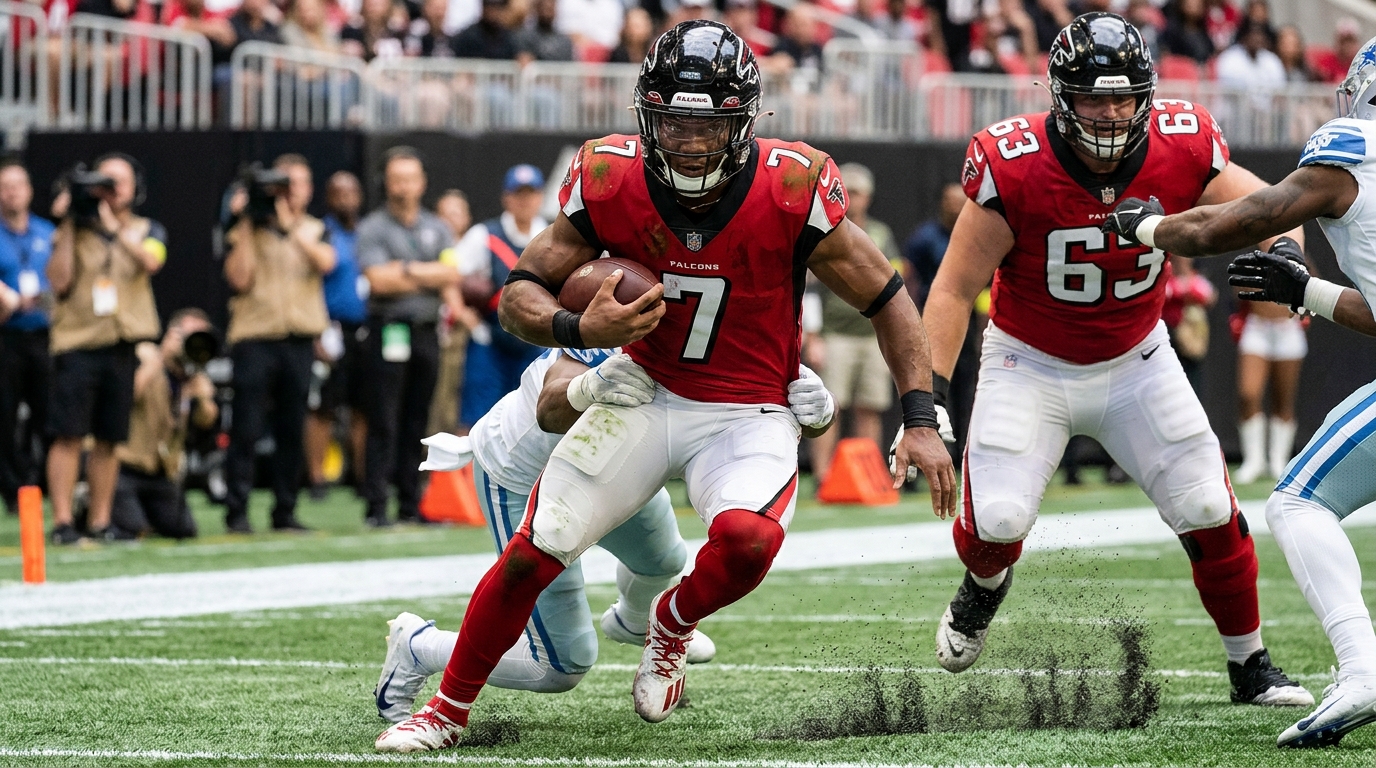
No player embodies that better than Bijan Robinson.
The gap at the top
Through 12 games in Season 36, Robinson has rushed for 2,146 yards and 24 touchdowns on 241 carries. That is 8.9 yards per carry and 178.8 yards per game, and a lead of 679 yards over the league’s second-ranked rusher, Jordan Mason of Minnesota, who has 1,467. It is a gap, not a margin. It is not a close race. It is a separation.
Atlanta’s team numbers tell the same story from a different angle. The Falcons lead the league in rushing at 224.7 yards per game, in scoring at 39.7 points per game, and in total offense at 5,099 yards. They rank 29th in passing yards, at 200.3 per game. In a league built around quarterbacks and spread passing attacks, Atlanta has built the most productive offense in 2KOLF by doing the opposite: handing the ball to its best player in a multi-power-run scheme and daring opponents to stop it for four quarters.
Fifth in the NFC, first in the run game
So far, they cannot. Atlanta is 9-3, has won five consecutive games, and is marked as a playoff-berth team. The Falcons are listed fifth in the NFC, not because of their record, but because Carolina, at 10-2, leads the NFC South. That seeding quirk matters. Atlanta has a better record than both the 8-4 Eagles and the 8-4 Packers, who are seeded third and fourth as division leaders, yet Atlanta would open the playoffs on the road if the season ended today. The Week 18 trip to Carolina, the final game on Atlanta’s schedule, could decide more than a division title. It could decide where Atlanta’s running game has to travel in January.
Not a steady accumulation
Robinson’s season has not been a steady accumulation of 100-yard games. He ran for 293 yards and three touchdowns at Green Bay in Week 3, and 228 yards and three touchdowns against Cincinnati in Week 9, games in which Atlanta did not need to be balanced because one player was enough.
The most recent stretch has been even more emphatic. After Atlanta’s Week 11 bye, Robinson rushed for 337 yards and four touchdowns on 22 carries at Minnesota in Week 12, a 62-55 win in which he averaged 15.3 yards per carry. A week later, against Detroit, he carried 22 times for 165 yards and three touchdowns in a 51-34 win. In two games, he gained 502 yards and scored seven rushing touchdowns. Defenses have had a bye week, a road trip, and a home game to prepare for him, and the production has only increased.
The Week 10 outlier
That makes the Week 10 game against Kansas City worth noting, rather than ignoring. Robinson carried only twice for seven yards in Atlanta’s 20-10 win over the Chiefs. Why his workload was so limited remains unclear. Atlanta won that game without a big day from its star, then returned from its bye and watched him produce two of his best rushing performances of the season. The outlier does not change the trend. If anything, it sharpens it.
More than a runner
Robinson is not only a runner in this offense. He has caught 19 passes for 293 yards and a touchdown, averaging 15.4 yards per reception, with a long reception of 74 yards. His longest run is 69 yards, he has 35 broken tackles, and he has 27 runs of 20 yards or more. Those numbers explain why Atlanta’s rushing lead is not built on volume alone. Robinson is averaging 20.1 carries per game, a heavy but not unreasonable workload, and turning those carries into explosive plays.
Can it hold up in January?
Can it hold up in the playoffs? A run-first team that ranks 29th in passing yards is betting its identity will travel and that it will not be forced into a shootout it cannot win through the air. Atlanta has allowed 375 points in 12 games, 31.3 per game, so the Falcons have rarely won low-scoring games. Their formula has been to score more, not to suffocate opponents.
But it is also why this story is worth covering now, rather than waiting for the postseason to render a verdict. Atlanta is not sneaking into the playoffs. It is arriving with the league’s rushing leader, the league’s highest-scoring offense, and a five-game winning streak, while sitting fifth in its conference because of a division race it has not yet won.
The Falcons have found an identity, and Robinson is the reason it works. Other teams have better passing attacks or better records, but Robinson’s 2,146 yards and 24 touchdowns are the numbers driving Atlanta’s run. Atlanta’s remaining tests are at Cleveland, at Washington, at home against Tampa Bay and New Orleans, and at Carolina to close the season. If the Falcons keep running this way, the question will not be whether Atlanta can score enough. It will be whether anyone, in a single game that matters, can make Atlanta stop.