

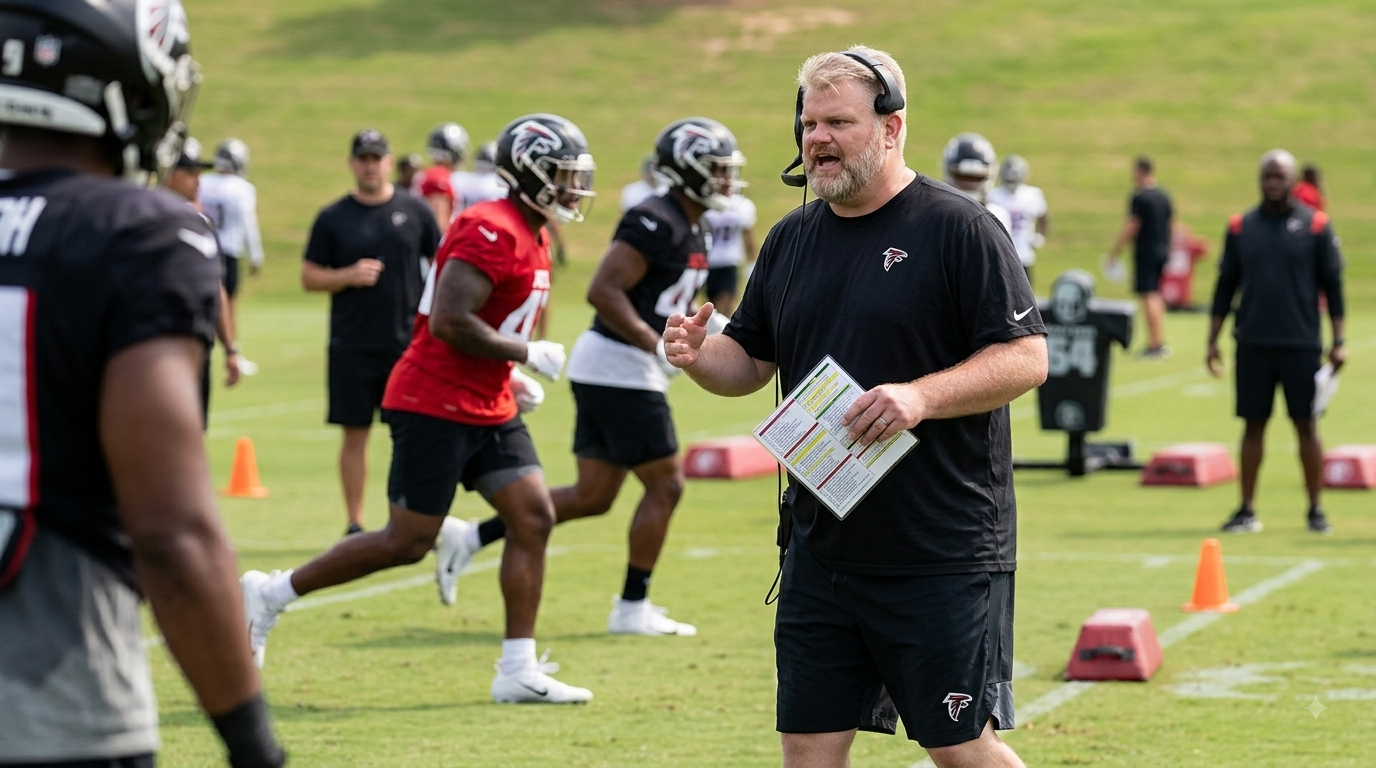
FLOWERY BRANCH, GA - There have been better summers in Atlanta, but perhaps that is exactly why Season 36 feels so important.
The Atlanta Falcons are coming off a 4-13 season that left them at the bottom of the NFC South and continued a difficult two-year stretch under head coach Chuck Davis. The numbers behind that record were every bit as uncomfortable as the final standings: Atlanta scored only 266 points, allowed 455 and finished with a minus-189 point differential.
Yet the Falcons preparing for Season 36 will not simply be last year's team trying again. The quarterback room has changed, the backfield could have an entirely different identity, several veteran additions have arrived, six rookies are trying to carve out roles, and training camp has already produced both encouraging developments and one significant setback.
For Davis, who has been part of Atlanta's history since the earliest days of 2K OLF, the task is straightforward even if accomplishing it will not be: make the Falcons relevant again.
Season 35 Left Plenty to Fix
Atlanta never developed a consistent offensive identity during Season 35.
The Falcons averaged just 15.6 points and 270 yards per game, converted 34.5 percent of their third downs and surrendered 56 sacks. The running game was an even greater problem, producing only 56.4 yards per game and four rushing touchdowns across the entire season. Atlanta quarterbacks threw 24 touchdown passes against 19 interceptions.
Michael Penix Jr. started 12 games and finished with 2,325 passing yards, 15 touchdowns and 11 interceptions, completing 53.7 percent of his passes with a 74.7 quarterback rating. Josh Davis appeared in seven games and added 1,347 yards, nine touchdowns and eight interceptions.
There were individual bright spots. Joey Holloway caught 80 passes for 1,173 yards and nine touchdowns, while Nick Nash added 874 yards and Kyle Pitts finished with 600. On defense, Bralen Trice led Atlanta with seven sacks, Troy Andersen recorded a team-high 74 tackles and A.J. Terrell Jr. intercepted two passes.
Those performances were not enough to overcome an offense that struggled to stay on schedule and a defense that allowed 26.8 points and nearly 360 yards per game. By the end of the season, Atlanta was not looking for one small adjustment. It needed a broader reset.
The Quarterback Question Has Changed Completely
That reset begins at quarterback.
Penix enters Season 36 after a difficult Season 35 and is still working his way back physically. During training camp, he has been limited in some full-team work while continuing to receive opportunities in 7-on-7 periods.
Meanwhile, Tua Tagovailoa has arrived in Atlanta and created a legitimate decision for Davis. The Falcons signed Tagovailoa during the offseason, adding an experienced quarterback to a room that no longer allows Penix to enter the season unchallenged.
The timing has made training camp particularly interesting. Tagovailoa has begun showing greater comfort with the offense, improving his command of the system and delivering several difficult throws during full-team work.
Atlanta does not need to make the Season 36 decision today, and Penix's health remains part of the equation. But after the Falcons received a combined 24 touchdowns and 19 interceptions from their quarterbacks last season, Davis now has a competition that could determine the direction of the entire offense.
Bijan Robinson Could Completely Change Atlanta's Identity
Perhaps no addition to the Season 36 version of Atlanta's offense matters more than Bijan Robinson.
For a 2K OLF team that rushed for only 956 yards as a group last season, the opportunity to build an offense around Robinson represents an enormous change. Atlanta has also made its commitment to him clear, signing the star running back to a three-year extension that keeps him with the franchise through 2030.
He has already provided flashes of what the offense could look like. During camp, Robinson returned to 11-on-11 work and immediately created one of the practice's biggest plays on a wheel route from Tagovailoa, separating from the defense for what would have been a touchdown in live action.
The Falcons also signed Brian Robinson Jr., giving Davis another proven option in the backfield.
That combination could allow Atlanta to build an offense that looks almost nothing like the one from Season 35. Last year, the Falcons averaged 3.3 yards per rushing attempt and scored four times on the ground. In Season 36, Davis should have the personnel to make opposing defenses account for the running game before they ever start worrying about Penix or Tagovailoa.
There Are More Weapons Around the Quarterback, Too
The changes extend beyond the backfield.
Drake London gives Atlanta an established centerpiece at receiver, while offseason addition Jahan Dotson adds another experienced target with speed. Olamide Zaccheaus has returned to Atlanta, Kyle Pitts remains at tight end, and Austin Hooper is back with the franchise as well.
Then there is rookie Zachariah Branch, selected 79th overall. Atlanta used its second draft selection on the Georgia receiver, adding another young playmaker to an offense that badly needed more ways to create pressure on a defense.
Protection received attention as well. Veteran tackle Jawaan Taylor signed during the offseason and has been working his way back into full participation, while seventh-round rookie Ethan Onianwa has taken increased first-team reps during Taylor's gradual return.
After giving up 56 sacks in Season 35, any improvement up front could be just as important as the new skill-position talent.
The Defense Has Already Been Forced to Adjust
Atlanta's defensive rebuild has not made it through training camp untouched.
The biggest blow came when Jalon Walker tore his ACL, ending his Season 36 before it could begin. Walker had been expected to become one of the foundations of the Falcons defense after contributing 2.5 sacks during Season 35, but Atlanta will now have to replace that expected production before the season even starts.
The linebacker room changed again when Atlanta released Troy Andersen, who led Davis' Season 35 defense with 74 tackles.
That puts additional pressure on some of the younger additions.
Atlanta used the 134th overall pick on linebacker Kendal Daniels and later selected Harold Perkins Jr. at No. 215. Both have received additional opportunities during camp as the Falcons work through changes at linebacker. Defensive tackle Anterio Thompson was another Day 3 addition.
The secondary may contain the most interesting rookie story of all. Atlanta selected Avieon Terrell with the 48th overall pick, putting him in the same cornerback room as his older brother, A.J. Terrell Jr.
For Davis, the defensive question is no longer simply whether Atlanta can improve on the 455 points it surrendered last season. He now has to determine how quickly a collection of new and young defenders can assume larger responsibilities after losing two significant pieces from last year's unit.
Chuck Davis and Atlanta Go Back to the Beginning
Season 36 is hardly Davis' first attempt at building something in Atlanta.
His association with the Falcons goes all the way back to Season 1, when he guided Atlanta to a 13-3 record and an NFC South championship. He followed that with a 14-2 Season 2, giving the Falcons a remarkable 27-5 regular-season record over the league's first two seasons.
Season 3 brought a 6-10 finish before Davis moved on to the St. Louis Rams, where he went 11-5 in Season 4 and 3-13 in Season 5.
His career eventually brought him back to Atlanta multiple times. The database shows later Falcons teams going 8-8 in Season 16, 9-7 in Season 17 and 10-6 in Season 18 before another departure. Years later, Davis returned again and produced one of the strongest stretches of his more recent Atlanta tenure.
The high point came in Season 28.
That Falcons team went 12-5, defeated the Los Angeles Rams 35-21 in the Divisional Round and came within three points of reaching the Super Bowl, falling 31-28 to the Dallas Cowboys in the NFC Championship Game.
Season 29 ended with a Wild Card loss, but Atlanta bounced back with another 10-7 campaign in Season 30. The Falcons beat the Los Angeles Rams 31-15 in the Wild Card round before the San Francisco 49ers escaped with a 34-33 Divisional Round victory.
Davis eventually got Atlanta back to 10-7 and the postseason again in Season 33, but the last two years have gone sharply in the opposite direction. A 5-12 Season 34 was followed by last year's 4-13 finish.
That recent slide is what makes Season 36 different. Davis has already demonstrated that he can build winning Falcons teams.
Now he has to show that he can do it again.
Atlanta's Standard Goes Beyond Any One Coach
There is also a larger franchise history hovering over this rebuild.
The Falcons have reached the Super Bowl multiple times during the 2K OLF era, and not all of those runs belonged to Davis. Atlanta won championships in Seasons 10 and 12 and returned to the Super Bowl in Season 14, where the Falcons finished as league runner-up.
That matters because this is not a franchise without history or expectations. Different coaches and different rosters have taken Atlanta deep into the postseason over the years.
Davis himself has been part of that history since Season 1, but Season 36 is not about nostalgia. The banners from previous eras do not make a 4-13 season disappear.
They simply provide a reminder of what Atlanta has looked like when things were working.
Three Questions Entering Season 36
The first question is the obvious one: Who becomes QB1? Penix remains part of the long-term picture, but his recovery has limited some of his full-team work while Tagovailoa has begun settling into the offense. How Davis handles that decision could shape everything that follows.
The second is whether Robinson can transform a running game that was almost nonexistent in Season 35. Atlanta cannot afford another season averaging fewer than 60 rushing yards per game, and the combination of Bijan Robinson and Brian Robinson Jr. gives Davis drastically different options.
The third is whether the defense can survive the loss of Walker while developing its young talent quickly enough. Avieon Terrell, Daniels, Perkins and Thompson may all be rookies, but Atlanta may not have the luxury of bringing every one of them along slowly.
Season 36 Outlook
It would be difficult to look at a 4-13 record and call the Atlanta Falcons a finished product.
They are not.
But they also do not look like the same team that ended Season 35.
There is a legitimate quarterback competition. Bijan Robinson gives Atlanta the potential centerpiece for a rebuilt rushing attack. London, Dotson, Pitts and Branch give the passing game options. The offensive line has received reinforcements, and the defense is being reshaped around a mixture of established players and young talent.
The loss of Walker hurts, Penix's recovery creates uncertainty and nothing about the last two seasons suggests Atlanta should simply be penciled back into contention. But Chuck Davis has been around long enough to know how quickly things can change. He coached a 12-win Falcons team to within three points of a Super Bowl in Season 28, then watched the franchise eventually slide to four wins seven seasons later.
Season 36 gives him another chance to reverse the direction.
For Atlanta, a reset would be welcome. A return to relevance would be even better.
Best article to date! Get em Coach!
LFG!!! #RiseUp